
Index Funds vs ETFs: What's the Difference and Which Should I Pick?

If you've started reading about investing, you've probably seen these two terms thrown around as if they're completely different things. They're not. They're more like two different vehicles that can take you to exactly the same destination. The difference is mostly about how they're bought and sold, not what's inside them.

This article explains what index funds and ETFs actually are, where they overlap, where they differ, and how to decide which one makes sense for your situation as a UK investor.

First, what they have in common

Both index funds and ETFs are types of passive investment fund. That means they track an index, like the FTSE 100, the S&P 500, or a global stock market index, rather than trying to beat it. A fund manager doesn't pick individual shares. Instead, the fund holds all (or a representative sample of) the shares in the index, in roughly the same proportions.

Because there's no active stock-picking, the fees are low, usually between 0.05% and 0.25% a year. Over decades, those low fees compound into significantly more money in your pocket compared to actively managed funds that charge 0.75% to 1.5%.

An index fund and an ETF tracking the same index will give you virtually identical returns. The wrapper is different, the contents are the same.

What an index fund is

An index fund (in the UK, technically called an index tracker fund, unit trust or OEIC) is a pooled fund that you buy directly from the fund provider or through an investment platform. You place an order, and the fund buys or sells units at the end of the trading day at a single price.

Key features:

  • Priced once a day, usually at midday.

  • You invest a specific pound amount (e.g., £100), and you get whatever number of units that buys, including fractions.

  • Most UK platforms let you set up a regular monthly investment easily.

  • No dealing fees on many platforms when buying funds (Vanguard, for example).

What an ETF is

An ETF (exchange-traded fund) is a fund that trades on the stock exchange, just like a share. You buy and sell it through a broker during market hours, and its price moves throughout the day.

Key features:

  • Priced continuously during market hours.

  • You buy whole shares (or fractional shares on some platforms), so you might invest £98.50 instead of exactly £100.

  • There may be a dealing fee per trade on some platforms, though many now offer commission-free ETF trading.

  • Tends to have slightly lower ongoing charges than the equivalent index fund, though the difference is often tiny.

The real differences, in plain English

How you buy

Index funds: you say "I want to invest £200" and the fund gives you however many units that buys. ETFs: you say "I want to buy 3 shares of this ETF" and you pay whatever 3 shares cost at that moment.

When the price is set

Index funds: once a day. ETFs: throughout the trading day. For a long-term buy-and-hold investor, this makes essentially no difference. You're not day-trading either of them.

Fees

ETFs often have marginally lower ongoing charges (0.07% vs 0.12%, for example). But some platforms charge dealing fees for ETF trades and none for index fund trades, which can wipe out the saving if you're investing small amounts regularly.

Ease of regular investing

Index funds win here. Most UK platforms let you set up an automatic monthly investment into a fund. Setting up the same automation for ETFs is possible on some platforms (InvestEngine, Trading 212) but not all.

Range

ETFs have a wider range of niche products: sector ETFs, commodity ETFs, bond ETFs, thematic ETFs. If you want broad market exposure (which is what most beginners need), both have you covered.

Which should you pick?

Pick an index fund if:

  • You want to invest a fixed pound amount each month (e.g., "£200 on the 1st").

  • You like the idea of set-and-forget automation.

  • Your platform charges no dealing fees on funds but does charge for ETF trades.

  • You're investing through Vanguard's own platform (which primarily offers funds).

Pick an ETF if:

  • Your platform charges no dealing fees for ETFs (Trading 212, InvestEngine, Freetrade).

  • You want the lowest possible ongoing charge and don't mind buying whole shares.

  • You're investing a lump sum rather than a regular monthly amount.

  • You want access to specific or niche exposures not available as a fund.

It genuinely doesn't matter much

If both track the same index, the long-term difference in your returns will be tiny. The far bigger factor is whether you actually invest consistently, not whether you use a fund or an ETF to do it.

Don't let this decision become the reason you don't start.

A practical example

Say you want to invest £200 a month into a global tracker inside a Stocks and Shares ISA.

Option A: Vanguard FTSE Global All Cap Index Fund on the Vanguard platform. Ongoing charge: 0.23%. No dealing fees. You set up a monthly direct debit, invest exactly £200, get fractional units, and forget about it.

Option B: Vanguard FTSE All-World UCITS ETF (VWRL) on Trading 212. Ongoing charge: 0.22%. No dealing fees. You buy however many whole shares £200 covers each month (or use fractional shares if available on your platform).

Over 20 years, the difference in total returns between these two would be negligible. Both give you broad global equity exposure at rock-bottom cost.

Common doubts

  • "Are ETFs riskier because they trade like shares?" No. The underlying assets are the same. The fact that ETFs have a live price during the day doesn't make them more volatile. It just means you can see the price moving. With an index fund, the price moves too, you just don't see it until end of day.

  • "Can I hold ETFs in an ISA?" Yes. Most UK platforms let you hold ETFs inside a Stocks and Shares ISA, exactly the same as funds.

  • "What about accumulating vs distributing?" Both index funds and ETFs come in two flavours: accumulating (dividends are automatically reinvested) and distributing/income (dividends are paid out as cash). For long-term growth, accumulating is usually simpler.

  • "Should I switch from one to the other?" Only if you'd save meaningful money on fees. Otherwise, stick with what you have. Switching can trigger capital gains events outside an ISA.

Where Mona fits

Mona doesn't pick your fund or ETF for you, but she makes sure the money shows up every month. She links to your UK bank via Open Banking, tracks your investment contributions, and keeps you on pace with your goals. Whether you're buying a Vanguard fund or a global ETF, the hardest part is consistency. That's where Mona helps most.

This article is for education only and is not financial advice. For free, impartial guidance on investing, MoneyHelper.org.uk (run by the UK government's Money and Pensions Service) has a useful beginner's guide to funds and shares.

The bottom line

Index funds and ETFs are two ways of holding the same thing. Index funds are easier for regular monthly investing. ETFs sometimes have marginally lower fees and more variety. For most UK beginners, either one works brilliantly.

The choice between them matters far less than the choice to start investing in the first place.

Pick the one your platform makes cheapest and easiest. Then automate it and get on with your life.

Choose a global index fund or global ETF on the platform you already use, set up a monthly contribution inside your ISA, and stop comparing the two. They both work.

Join Mona’s early access waitlist

Index Funds vs ETFs: What's the Difference and Which Should I Pick?
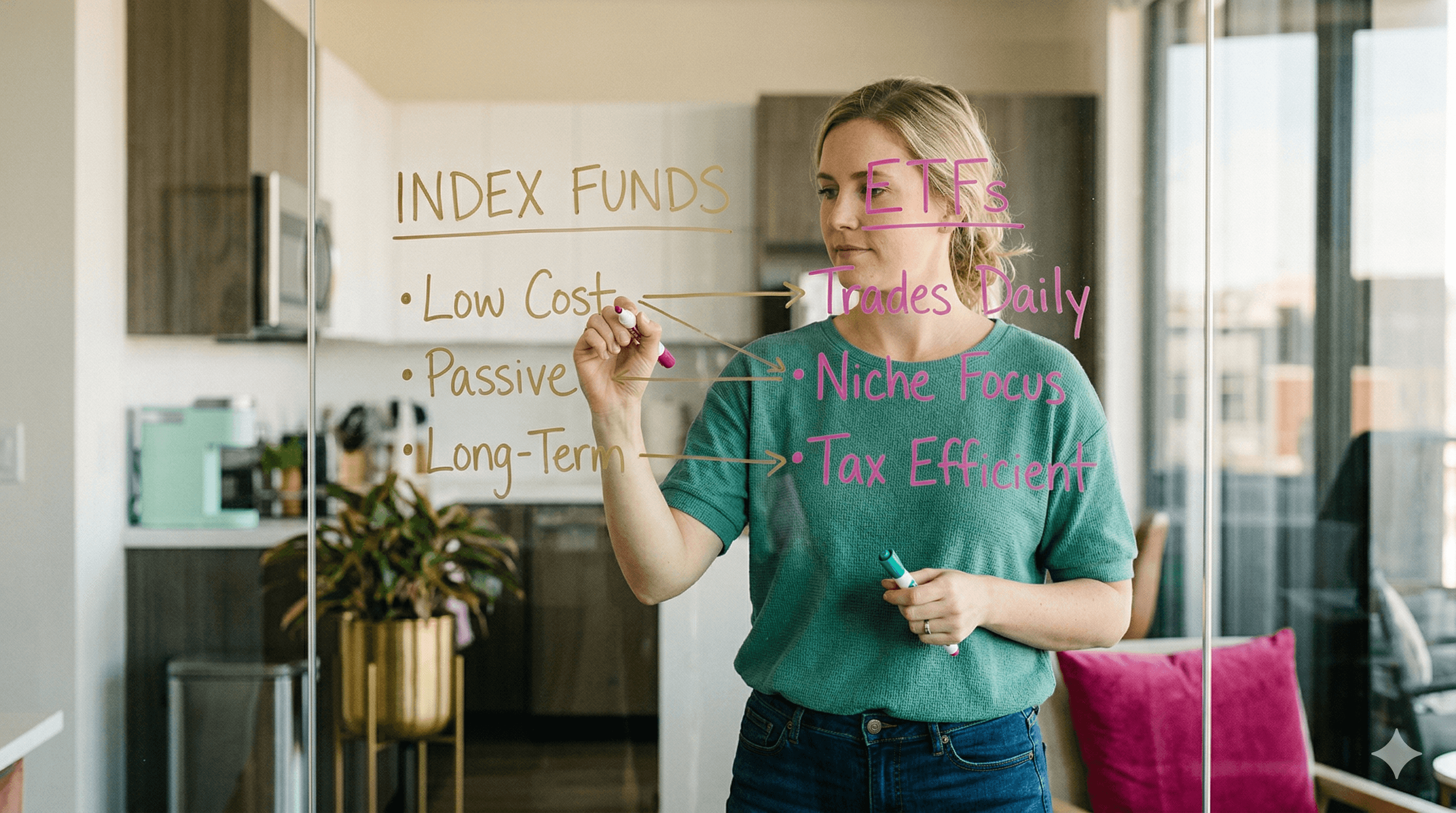
If you've started reading about investing, you've probably seen these two terms thrown around as if they're completely different things. They're not. They're more like two different vehicles that can take you to exactly the same destination. The difference is mostly about how they're bought and sold, not what's inside them.

This article explains what index funds and ETFs actually are, where they overlap, where they differ, and how to decide which one makes sense for your situation as a UK investor.

First, what they have in common

Both index funds and ETFs are types of passive investment fund. That means they track an index, like the FTSE 100, the S&P 500, or a global stock market index, rather than trying to beat it. A fund manager doesn't pick individual shares. Instead, the fund holds all (or a representative sample of) the shares in the index, in roughly the same proportions.

Because there's no active stock-picking, the fees are low, usually between 0.05% and 0.25% a year. Over decades, those low fees compound into significantly more money in your pocket compared to actively managed funds that charge 0.75% to 1.5%.

An index fund and an ETF tracking the same index will give you virtually identical returns. The wrapper is different, the contents are the same.

What an index fund is

An index fund (in the UK, technically called an index tracker fund, unit trust or OEIC) is a pooled fund that you buy directly from the fund provider or through an investment platform. You place an order, and the fund buys or sells units at the end of the trading day at a single price.

Key features:

  • Priced once a day, usually at midday.

  • You invest a specific pound amount (e.g., £100), and you get whatever number of units that buys, including fractions.

  • Most UK platforms let you set up a regular monthly investment easily.

  • No dealing fees on many platforms when buying funds (Vanguard, for example).

What an ETF is

An ETF (exchange-traded fund) is a fund that trades on the stock exchange, just like a share. You buy and sell it through a broker during market hours, and its price moves throughout the day.

Key features:

  • Priced continuously during market hours.

  • You buy whole shares (or fractional shares on some platforms), so you might invest £98.50 instead of exactly £100.

  • There may be a dealing fee per trade on some platforms, though many now offer commission-free ETF trading.

  • Tends to have slightly lower ongoing charges than the equivalent index fund, though the difference is often tiny.

The real differences, in plain English

How you buy

Index funds: you say "I want to invest £200" and the fund gives you however many units that buys. ETFs: you say "I want to buy 3 shares of this ETF" and you pay whatever 3 shares cost at that moment.

When the price is set

Index funds: once a day. ETFs: throughout the trading day. For a long-term buy-and-hold investor, this makes essentially no difference. You're not day-trading either of them.

Fees

ETFs often have marginally lower ongoing charges (0.07% vs 0.12%, for example). But some platforms charge dealing fees for ETF trades and none for index fund trades, which can wipe out the saving if you're investing small amounts regularly.

Ease of regular investing

Index funds win here. Most UK platforms let you set up an automatic monthly investment into a fund. Setting up the same automation for ETFs is possible on some platforms (InvestEngine, Trading 212) but not all.

Range

ETFs have a wider range of niche products: sector ETFs, commodity ETFs, bond ETFs, thematic ETFs. If you want broad market exposure (which is what most beginners need), both have you covered.

Which should you pick?

Pick an index fund if:

  • You want to invest a fixed pound amount each month (e.g., "£200 on the 1st").

  • You like the idea of set-and-forget automation.

  • Your platform charges no dealing fees on funds but does charge for ETF trades.

  • You're investing through Vanguard's own platform (which primarily offers funds).

Pick an ETF if:

  • Your platform charges no dealing fees for ETFs (Trading 212, InvestEngine, Freetrade).

  • You want the lowest possible ongoing charge and don't mind buying whole shares.

  • You're investing a lump sum rather than a regular monthly amount.

  • You want access to specific or niche exposures not available as a fund.

It genuinely doesn't matter much

If both track the same index, the long-term difference in your returns will be tiny. The far bigger factor is whether you actually invest consistently, not whether you use a fund or an ETF to do it.

Don't let this decision become the reason you don't start.

A practical example

Say you want to invest £200 a month into a global tracker inside a Stocks and Shares ISA.

Option A: Vanguard FTSE Global All Cap Index Fund on the Vanguard platform. Ongoing charge: 0.23%. No dealing fees. You set up a monthly direct debit, invest exactly £200, get fractional units, and forget about it.

Option B: Vanguard FTSE All-World UCITS ETF (VWRL) on Trading 212. Ongoing charge: 0.22%. No dealing fees. You buy however many whole shares £200 covers each month (or use fractional shares if available on your platform).

Over 20 years, the difference in total returns between these two would be negligible. Both give you broad global equity exposure at rock-bottom cost.

Common doubts

  • "Are ETFs riskier because they trade like shares?" No. The underlying assets are the same. The fact that ETFs have a live price during the day doesn't make them more volatile. It just means you can see the price moving. With an index fund, the price moves too, you just don't see it until end of day.

  • "Can I hold ETFs in an ISA?" Yes. Most UK platforms let you hold ETFs inside a Stocks and Shares ISA, exactly the same as funds.

  • "What about accumulating vs distributing?" Both index funds and ETFs come in two flavours: accumulating (dividends are automatically reinvested) and distributing/income (dividends are paid out as cash). For long-term growth, accumulating is usually simpler.

  • "Should I switch from one to the other?" Only if you'd save meaningful money on fees. Otherwise, stick with what you have. Switching can trigger capital gains events outside an ISA.

Where Mona fits

Mona doesn't pick your fund or ETF for you, but she makes sure the money shows up every month. She links to your UK bank via Open Banking, tracks your investment contributions, and keeps you on pace with your goals. Whether you're buying a Vanguard fund or a global ETF, the hardest part is consistency. That's where Mona helps most.

This article is for education only and is not financial advice. For free, impartial guidance on investing, MoneyHelper.org.uk (run by the UK government's Money and Pensions Service) has a useful beginner's guide to funds and shares.

The bottom line

Index funds and ETFs are two ways of holding the same thing. Index funds are easier for regular monthly investing. ETFs sometimes have marginally lower fees and more variety. For most UK beginners, either one works brilliantly.

The choice between them matters far less than the choice to start investing in the first place.

Pick the one your platform makes cheapest and easiest. Then automate it and get on with your life.

Choose a global index fund or global ETF on the platform you already use, set up a monthly contribution inside your ISA, and stop comparing the two. They both work.
Join Mona’s early access waitlist