
FTSE 100 at Record Highs: Is Now a Bad Time to Start Investing?
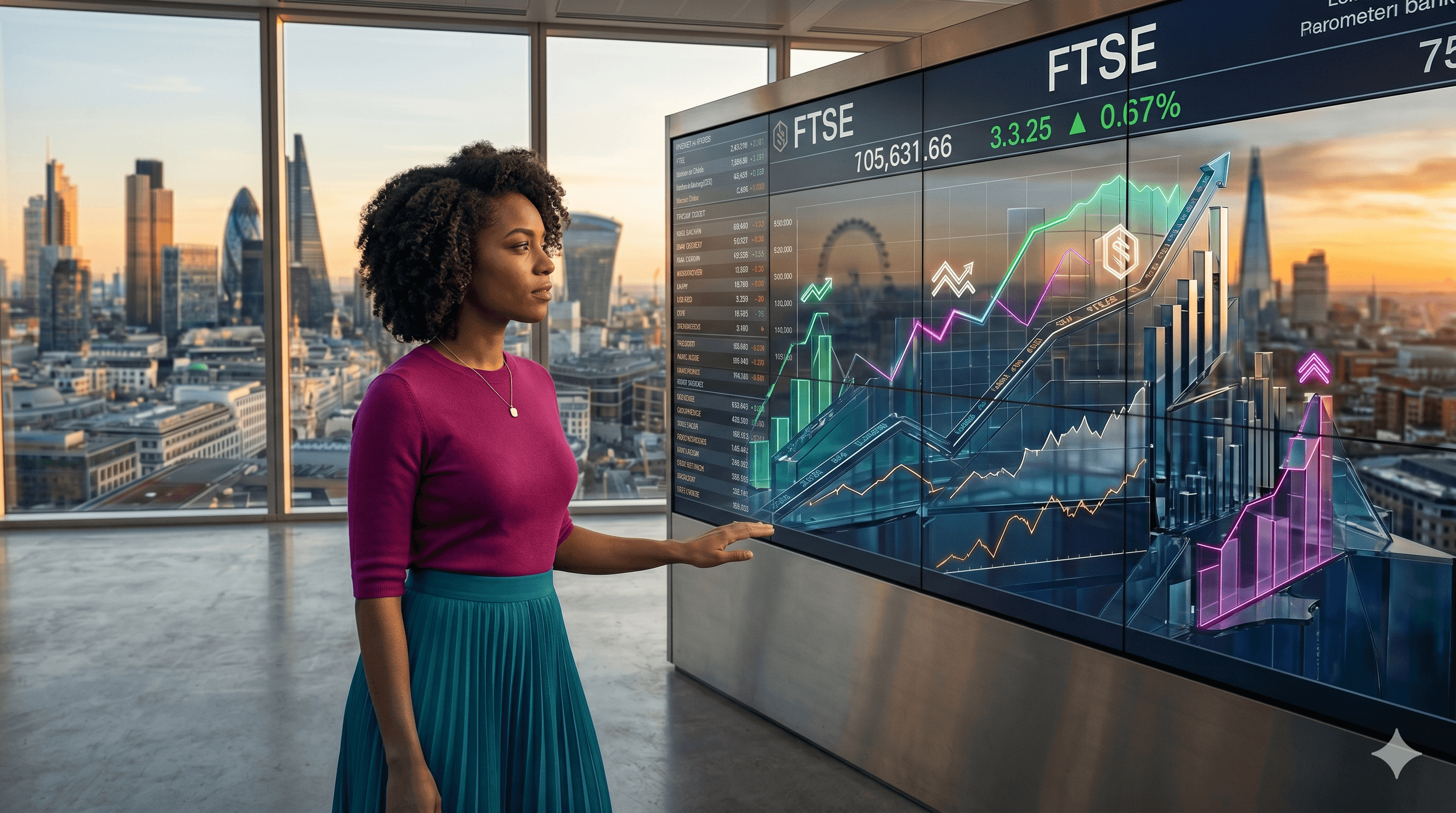
The FTSE 100 keeps breaking records. If you're wondering whether it's too late to start, here's the honest answer.
Is it a bad idea to invest when markets are at record highs?
No. Record highs feel scary, but history shows they're a normal part of healthy markets, not a warning sign. The FTSE 100, the S&P 500 and most major global indices spend a surprising amount of their time at or near all-time highs, because markets rise more years than they fall. Waiting for a "better" entry point has historically cost investors far more than simply starting.
Research by JP Morgan found that investing at all-time highs has, on average, produced similar or better returns over the following one, three and five years compared to investing on any random day. That's counterintuitive, but it reflects a simple truth: markets trend upwards over the long run, and new highs often lead to further highs.
Why does it feel so wrong to buy at the top?
Because our brains are wired to fear buying anything right before the price drops. In other parts of life (houses, cars, clothes) this instinct serves us well. In investing, it's actively harmful. Trying to time the market requires being right twice: you need to get out before a fall and get back in before the recovery. Almost nobody does this consistently.
The worst outcome is usually doing nothing. Sitting in cash while waiting for a crash means missing years of compounding growth. If the crash never comes (or comes only shallowly), you lose out permanently. If the crash does come, you then need the discipline to buy during the scariest moment, which most people struggle to do.
What does the data actually show about investing at highs?
A study of S&P 500 data from 1988 to 2023 found that money invested on days when the market hit an all-time high produced an average annual return of 14.6% over the following year, compared to 11.7% for money invested on any random day. Over three years, the numbers were similar. Over five years, they were essentially identical.
In other words, buying at record highs has not produced worse returns than buying on a random Tuesday. The data directly contradicts the fear. The only time record highs have led to significantly worse five-year returns was in a handful of cases where the high came right before a major bubble burst (1929, 1999). These were identifiable largely in hindsight.
Should you wait for a crash before starting?
No, and the maths is punishing. A study by Charles Schwab compared five investors: a perfect market-timer, a regular investor (investing on the same day each year), a lump-sum investor (investing on day one), a cash-holder, and an unlucky investor who always invested right before crashes. Over 20 years, the worst-timed investor still vastly outperformed the cash-holder. Simply being in the market, even badly timed, beat sitting out.
For most UK investors, the right approach is not to try to pick the bottom, but to start regular contributions into a Stocks and Shares ISA and let time and compounding do the work. Whether the market dips next month or not is far less important than whether you're invested for the next 20 years.
Does it matter that the FTSE 100 is heavily weighted to older industries?
It's a fair concern. The FTSE 100 is dominated by banks, oil and gas, miners, and pharmaceuticals, which look different to the tech-heavy US market. That's part of why UK investors are often better served by a global tracker fund rather than a pure FTSE 100 tracker. A global tracker gives you exposure to US technology, European industrials, Japanese exporters and emerging markets in one fund.
If you already have a FTSE 100 tracker, it's not "wrong", but it is more concentrated in a single country and in a few sectors. A Stocks and Shares ISA lets you hold global trackers, regional trackers or individual funds all inside the same tax-free wrapper, so you don't have to pick just one.
What if the market crashes right after you invest?
It might. Nobody can promise otherwise. But "right after you invest" is only painful if your time horizon is short. If you're investing for five, ten or twenty years, a short-term crash is noise. Over the last 50 years, the global stock market has recovered from every major crash (1987, 2000, 2008, 2020, 2022) and gone on to new highs. The investors who fared worst were those who sold after a crash and stayed out.
If the idea of a crash right after starting keeps you up at night, drip-feeding your money in over several months (a simple version of pound-cost averaging) reduces your exposure to bad timing at the cost of slightly lower expected returns. It's a reasonable behavioural compromise even if the data slightly favours lump-sum investing.
Where Mona Fits
Mona is designed to help you actually start, which is the biggest hurdle. A Stocks and Shares ISA with Mona gives you diversified exposure to global markets, and you can start with small regular contributions rather than trying to time a perfect lump-sum entry. The market's current level matters far less than whether you're invested for the long term. Mona helps you focus on what you can control (how much, how often, how long) and ignore what you can't.
The Bottom Line
Record highs feel like the worst time to invest. The data says otherwise. Markets spend large chunks of their time at or near highs, and investing at those highs has historically delivered similar or better returns over the following years compared to investing on average days. The bigger risk is sitting in cash waiting for a crash that may not come, or that comes too shallow to offset the compounding you missed. Start, stay invested, and diversify. Your long-term outcome depends far more on consistency than on timing.
Stop waiting for a perfect entry point. Start building wealth in your ISA with Mona today.
For impartial information and guidance on investing, visit MoneyHelper.org.uk.